Signs of Sewer Line Problems in San Antonio and What to Do Next
Know the signs of sewer line problems in your San Antonio home, what to do during a backup, and when to call a licensed plumber or SAWS.
Quick answer
The clearest signs of sewer line problems are more than one fixture backing up, wastewater coming up through a drain or an outdoor cleanout, and toilets that gurgle when other fixtures drain. Take them seriously. During a backup, stop using water, keep people and pets away, call a licensed plumber to inspect your side of the line, and report it to SAWS at 210-704-7297 so it can check its main.
Article Topics
- Why One Symptom Isn't a Diagnosis
- Signs of Sewer Line Problems Worth Acting On
- If Wastewater Is Backing Up Right Now
- Know Where Your Outdoor Cleanout Is
- What Causes Sewer Line Problems
- What a Camera Inspection Shows
- Your Side of the Line vs the SAWS Main
- Help With Sewer Repairs on Your Side
- What Goes Down the Drain
- When to Call a Plumber About Your Sewer Line
- Frequently asked questions
If you are watching for signs of sewer line problems in your San Antonio home, start with how your drains behave together. A sewer problem rarely announces itself clearly. It usually starts as something easy to explain away: a toilet that gurgles when the washing machine drains, or a tub that empties slower than it used to. Those signs matter, but none of them by itself proves your sewer line is broken.
What you can control is how early you notice the pattern, how you protect your home during a backup, and whether the line gets a proper inspection before a slow drain becomes wastewater on the floor.
Why One Symptom Isn't a Diagnosis
SAWS describes an obstruction as something that blocks the flow of wastewater and can cause it to back up through a manhole, cleanout, toilet, sink or drain. The U.S. EPA notes that sanitary sewer overflows can also result from line breaks, system defects, power failures, improper design or vandalism, and that overflows can back up into homes and threaten public health.
That range of causes is why one symptom is not a diagnosis. The point of noticing early is to get the line looked at, not to guess.
Signs of Sewer Line Problems Worth Acting On
- More than one fixture backing up. SAWS treats toilets and tubs backing up as a possible clogged sewer line and directs customers to a licensed plumber.
- Gurgling toilets. Gurgling when other fixtures drain can come from a partial blockage. Treat it as a reason to watch closely.
- Wastewater coming up a drain. If sewage flows out of a toilet, tub or floor drain, you are past watching and waiting.
- Anything coming out of a cleanout. SAWS lists the cleanout among the places wastewater can surface during an obstruction.
- Slow drains in several fixtures at once. One slow sink usually points to that sink's own drain. Sewer utilities list slow-draining fixtures and several fixtures backing up at the same time as warning signs of a service-line blockage.
- Clogs that keep coming back. If a drain cleaning restores flow and the same backup returns weeks later, ask for a camera inspection so you know what in the pipe keeps catching waste.
- Sewage odor or wet spots in the yard. A sewer smell outdoors, or a soggy patch along the path of the line with no rain or sprinkler to explain it, can point to a leak in the buried pipe.
One of these signs of sewer line problems by itself calls for watching. Two or more together, or anything surfacing at a drain or cleanout, calls for a licensed plumber. A single slow fixture is often a job for drain cleaning in San Antonio; repeated whole-house symptoms point to the main line.
If Wastewater Is Backing Up Right Now
- Stop using water throughout the house. No flushing, laundry, dishwasher or running taps.
- Keep people and pets away. SAWS warns that sewer overflows can carry bacteria and viruses.
- Arrange cleanup if needed. SAWS recommends calling a remediation (cleaning) company.
- Call a licensed plumber. SAWS directs customers to have a licensed plumber televise the line and clear any blockage on the customer's side of the main.
- Report the backup to SAWS at 210-704-7297 so it can inspect its sewer main.
- Document what you see with photos and times.
Steps 4 and 5 are not alternatives. They cover two different parts of the system.
An active backup is a job for urgent plumbing repair, not a routine appointment. If wastewater reached drywall, flooring or anything near outlets, stay clear of the wet area and read what to do when a leak reaches wiring and drywall before anything is switched back on.
Know Where Your Outdoor Cleanout Is
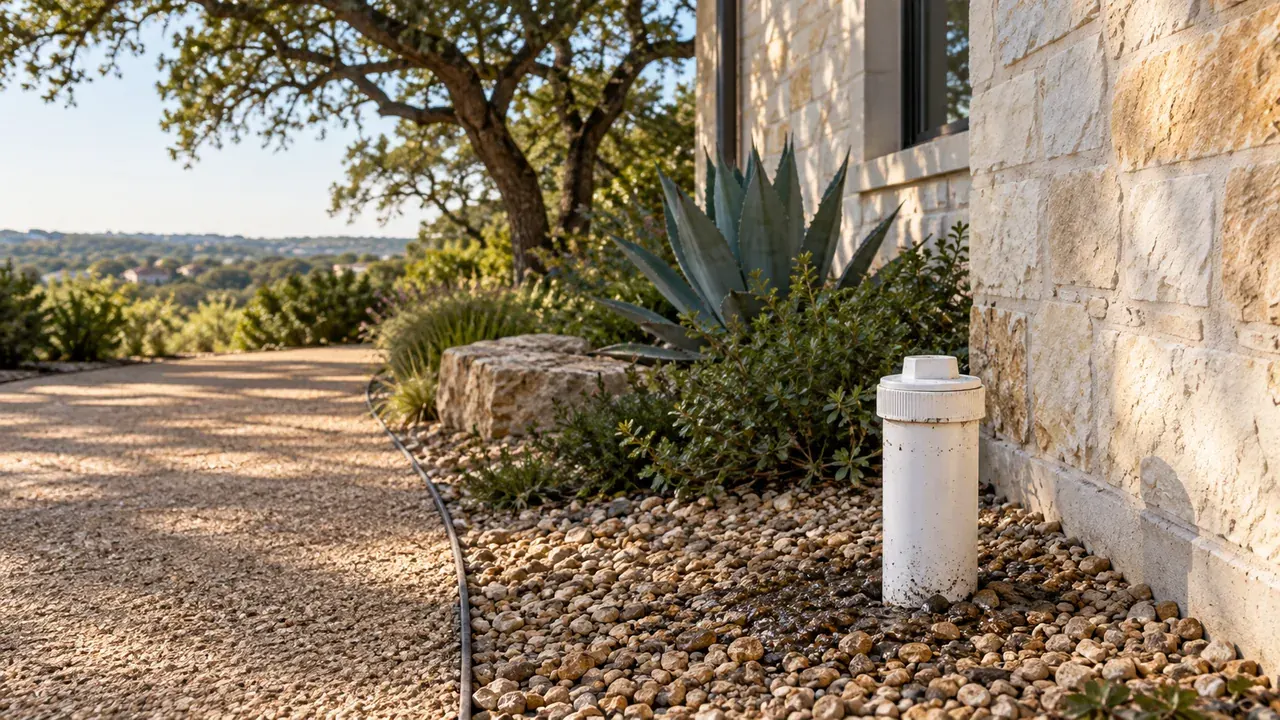
A sewer cleanout is a short pipe with a threaded cap that gives a plumber direct access to the line. Sewer utilities note that a vent or cleanout is often found on the exterior of a home with a visible cap, and SAWS lists the cleanout among the places wastewater can surface during an obstruction.
Find yours before you need it. If wastewater is seeping from around the cap, the blockage is usually farther down the line than that cleanout, in the sewer line itself rather than in one fixture's drain. Leave opening the cap to your plumber, since it may be holding back wastewater.
If your home has no accessible cleanout, your plumber may recommend adding one. SAWS notes that its sewer reimbursement process does not cover property improvements such as new cleanouts, so that cost stays with you.
What Causes Sewer Line Problems
The same symptoms can have very different causes, which is why the camera matters more than the symptom. The EPA lists blockages, line breaks, sewer defects that let stormwater and groundwater overload the system, power failures, improper sewer design and vandalism among the causes of sanitary sewer overflows. SAWS calls the build-up of solids and fats, oils and grease (FOG) in the collection system a major concern.
Tree roots belong on that list too. Sewer utilities name tree roots invading broken pipes as a common cause of blockages. If your line runs near large trees and backups return after each cleaning, ask your plumber to look specifically for root intrusion and pipe damage on the camera footage. Clearing roots restores flow, but it does not repair a cracked pipe.
What a Camera Inspection Shows
SAWS asks customers to have a licensed plumber televise the line, which means inspecting it with a video camera. The camera travels through the pipe and records what is inside, so you see the problem instead of guessing at it. It can show where a blockage sits, what is causing it, and whether the pipe is cracked, separated or sagging.
That footage drives the next decision:
- Clear the line when the pipe is sound and the problem is a blockage.
- Repair a section when damage is limited to one spot.
- Replace more of the line when the camera shows damage along much of its length.
Ask to see the footage, and ask where the problem sits relative to your property line. That location decides who handles the repair. Any sewer line repair quote should match what the camera actually shows.
Your Side of the Line vs the SAWS Main
SAWS separates the customer's side of the main from its own sewer main. Which side a backup starts on cannot be judged from inside the house; that is what a camera inspection is for.
SAWS says you may qualify for reimbursement of normal and customary charges to electronically locate the problem when your plumber locates the blockage beyond your property line, in the public right-of-way, street or alley. Its page explains the requirements, so read it directly and keep your plumber's documentation.
Under that process, your plumber electronically locates the line, marks the obstruction with green paint in an X and calls the SAWS Emergency Operations Center, and SAWS then decides whether repairs are necessary. You submit a legible receipt from your licensed plumber with your name, the repair address and your contact details, and SAWS says to allow 4 to 6 weeks for processing. SAWS does not pay for repairs or replacement of damaged property, and if the blockage is on your side, you are not entitled to reimbursement.
Help With Sewer Repairs on Your Side
If the problem is on your side and the cost is a hardship, look at SAWS Uplift before you schedule work. In March 2026, SAWS said its Plumbers to People and Laterals to People programs help income-qualified residential customers repair water leaks and sewer pipes, including shared or improperly routed sewer connections. To qualify, SAWS said customers must meet income requirements, own and live in the home, and have a home valued under $300,000.
Program funding and terms can change, so confirm current details at saws.org/uplift or by calling SAWS at 210-233-2273.
What Goes Down the Drain
SAWS identifies solids and fats, oils and grease as major obstruction concerns. Keep cooking grease and solids out of drains. That will not prevent line breaks or system defects, but it addresses the cause a household controls.
Scrape plates into the trash, let grease cool and throw it away, and use a strainer in the kitchen sink. Locating a problem precisely before anyone digs is the same principle that keeps slab leak repair costs under control: the exact location decides how much of your home gets opened up.
When to Call a Plumber About Your Sewer Line
Call a licensed plumber when you notice two or more signs of sewer line problems at once, when a clog keeps coming back, or when anything surfaces at a drain or cleanout. When wastewater is backing up, also call SAWS at 210-704-7297 so it can check its main. Ask for a camera inspection, ask to see the footage, and keep every receipt in case the problem turns out to be on the SAWS side.
For questions about drains, pipes and fixtures beyond the sewer line, start with plumbing service in San Antonio.
Frequently asked questions
Does a gurgling toilet mean my sewer line is broken?
Not by itself. Gurgling can come from a partial blockage anywhere in the drain system. Treat it as a reason to watch closely, especially if other fixtures drain slowly or back up.
My toilet and tub are both backing up. Is that a sewer line issue?
It can be. When several fixtures back up at once, SAWS directs customers to call a licensed plumber to camera-inspect the line and clear any blockage on the customer's side of the main.
Should I call SAWS or a plumber?
Both. A licensed plumber inspects and clears your side of the line, and SAWS asks customers to report backups at 210-704-7297 so it can inspect its sewer main. Make both calls as soon as wastewater starts backing up.
If the blockage turns out to be in the street, will SAWS reimburse me?
SAWS says you may qualify for reimbursement of normal and customary charges to locate the problem when your plumber finds the blockage beyond your property line. Eligibility and terms are set by SAWS, so read its page and keep your plumber's documentation.
Is a sewer backup a health risk?
Treat it as one. SAWS warns that sewer overflows can carry bacteria and viruses, and the EPA notes that overflows can threaten public health. Avoid contact with sewage and use a professional cleanup company when needed.
What are the most common signs of sewer line problems?
Watch for several fixtures backing up or draining slowly at the same time, toilets that gurgle when other fixtures drain, wastewater coming up through a floor drain, tub or outdoor cleanout, clogs that return after cleaning, and sewage odor or soggy spots in the yard. Two or more together call for a licensed plumber and a camera inspection.
Can SAWS help pay to repair the sewer line on my side?
Possibly. In March 2026, SAWS said its Plumbers to People and Laterals to People programs help income-qualified residential customers repair water leaks and sewer pipes. Customers must meet income requirements, own and live in the home, and have a home valued under $300,000. Check saws.org/uplift or call 210-233-2273 for current terms.
Sources
- San Antonio Water System, Plumbing Backed Up?. Retrieved October 13, 2026.
- San Antonio Water System, What's a Sanitary Sewer Overflow?. Retrieved October 13, 2026.
- U.S. Environmental Protection Agency, Sanitary Sewer Overflows (SSOs). Retrieved October 13, 2026.
- San Antonio Water System, SAWS Uplift helps bring 'Plumbers to People' (March 1, 2026). Retrieved October 13, 2026.
- Aspen Consolidated Sanitation District, Property Owner Responsibility. Retrieved October 13, 2026.
Seeing signs of sewer line problems?
For an active backup, stop using water first, then call 210-880-2864. C.S.W. Power Solutions is veteran-owned, performs plumbing under Responsible Master Plumber license RMP #46592, and can evaluate and repair the private side of the sewer line.
Related service: Sewer Line Repair Services
Online estimate appointments need at least 24 hours' notice. Need help sooner? Call 24/7: (210) 880-2864.
Or call 210-880-2864