How Far Should a Generator Be From the House in San Antonio?
How far should a generator be from the house? Separate portable CO distances from standby clearances, with CPS Energy guidance and San Antonio permit planning.
Quick answer
For a portable generator in San Antonio, CPS Energy says to stay at least 25 feet from a home or building. CDC guidance calls for outdoor operation more than 20 feet from windows, doors and vents. A permanently installed standby generator follows its exact model installation manual and local requirements instead. Its wall, opening, airflow and service clearances are separate checks; there is no single distance that approves every generator location.
Article Topics
- Portable or standby? Identify the equipment first
- Portable generators: keep the source of exhaust away
- Standby generators: wall clearance is only one measurement
- Walk the proposed San Antonio location before choosing a pad
- San Antonio permits: use the current backup-system bulletin
- Make the next step a location review
- Sources and further reading
Portable or standby? Identify the equipment first
The question sounds simple: how far should a generator be from the house? The useful answer starts with the equipment. A portable engine generator placed for temporary use and a permanently installed standby system have different placement instructions. Do not apply a standby unit's reduced wall clearance to a portable generator.
This guide helps you prepare a location for review. It does not approve a particular side yard, pad or installation. Keep the model and serial number handy, and use the instructions that belong to that unit. For an overview of the permanent system, visit our San Antonio generator installation and repair page.
Portable generators: keep the source of exhaust away
CPS Energy's Generator Safety guidance specifies at least 25 feet from a home or building for a portable generator. CDC carbon monoxide guidance says to operate it outdoors more than 20 feet from windows, doors and vents. The CPSC's 2026 hurricane-season safety release calls for at least 20 feet from homes, with exhaust directed away from buildings and openings.
These are separately attributed instructions, not a range from which to choose the smallest number. Plan around the local utility's 25-foot guidance while also meeting the opening separation and exhaust-direction instructions. Check neighboring buildings as well as your own, and follow the generator manual wherever it requires more.
Never run a portable generator in a garage, even with the door open, or in another enclosed area. Distance does not make an enclosed location safe. Do not connect a generator directly to house wiring yourself; CPS Energy says that connection requires a qualified electrician. Our generator hookup guide explains the connection-planning conversation.
Standby generators: wall clearance is only one measurement
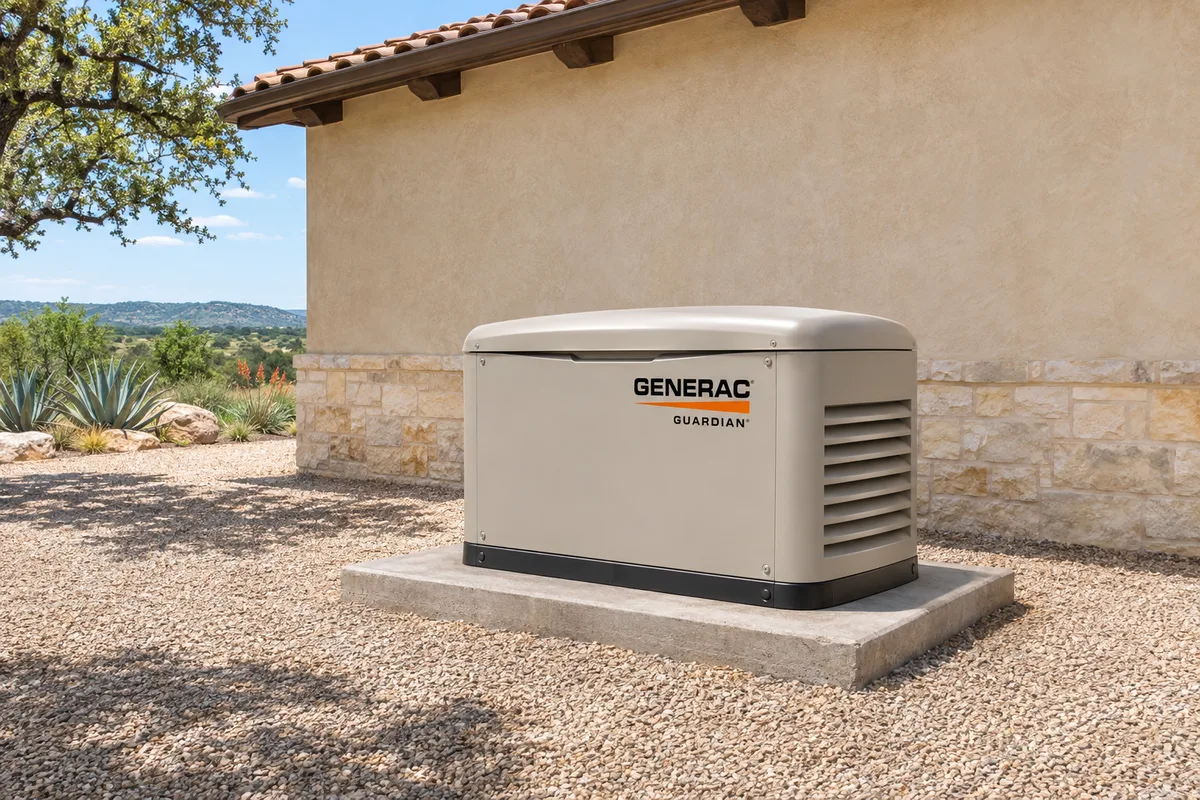
For an example of model-specific requirements, see Generac Installation Guidelines A0001846478 for 60 Hz air-cooled generators, 10–26 kW, Section 3, printed pages 15–16. That manual gives these enclosure clearances:
- Rear: 18 inches minimum.
- Front and ends: 3 feet minimum.
- Above the unit: 5 feet minimum.
Those figures apply to the equipment covered by that manual; they are not universal generator setbacks. The manual treats openings and existing walls under locally adopted codes. Its discussion of NFPA 37 describes a 5-foot opening separation and a tested reduction for certain combustible-wall offsets. The reduced wall offset does not reduce opening clearances.
Have the installer identify every relevant opening and the requirements for the exact unit. A closed window is not a substitute for that review. Generac also warns that exhaust can enter a structure even when minimum offsets are met, so a location may need greater separation. Keep the required space free for airflow and service. Read our Generac installation planning guide for the broader sequence.
Walk the proposed San Antonio location before choosing a pad
On a home in San Antonio, the shortest route from the electrical panel is only a starting point. Walk the proposed location from both inside and outside the house. A kitchen window, laundry vent or neighboring patio may change the location you thought would work.
Prepare a simple sketch for the installer: house walls, doors and windows; nearby buildings; fences and gates; trees and planting; the proposed generator and its orientation; the electrical equipment and proposed fuel route. Mark questions rather than claiming the sketch is an approved site plan.
Use these questions during the visit:
- Which model and manual revision govern this location?
- Which openings could receive exhaust, including those on a neighboring building?
- Can the required clear area remain open after landscaping grows or a fence is repaired?
- Where will service access be maintained?
- Who will confirm jurisdiction, utility coordination and the permit path before work begins?
A San Antonio mailing address does not establish the governing jurisdiction. Confirm the property location before relying on a City process, and have the contractor explain any property-specific restrictions.
San Antonio permits: use the current backup-system bulletin
The City of San Antonio's Development Services Information Bulletin 250, dated November 1, 2025 and revised October 1, 2026, describes third-party plan review and inspection of home backup systems for one- and two-family dwellings. It covers qualifying generators and associated transfer switches and references applicable codes and CPS Energy standards.
That process does not absorb every related trade into one approval. The bulletin excludes fuel-gas piping and connections from this third-party backup-system review path and points to the plumbing permit application. It also separates electric service and panel work. Ask who is responsible for each applicable permit, utility requirement and inspection. Do not treat this article or a manufacturer clearance drawing as a permit exemption.
For the overall project scope, our generator installation planning article covers sizing, transfer equipment and gas-supply questions without replacing the site assessment.
Make the next step a location review
Bring the proposed equipment model, a few site measurements and your placement questions to the contractor. Ask for the applicable manual drawing and a written explanation of the wall, opening and access checks. Resolve those questions before committing to the pad location.
C.S.W. Power Solutions is a veteran-owned San Antonio business. Explore our power solutions or generator services, then call 210-880-2864 to discuss the proposed location and project scope.
Sources and further reading
Public guidance checked November 6, 2026. Follow the instructions for your exact equipment and the requirements confirmed for your property.
Generator distance: frequently asked questions
How far should a portable generator be from the house in San Antonio?
CPS Energy specifies at least 25 feet from a home or building. CDC separately says to operate outdoors more than 20 feet from windows, doors and vents. Meet the local utility guidance, opening and exhaust-direction instructions, and the equipment manual; do not select the smallest number.
Does the 18-inch standby clearance apply to a portable generator?
No. The 18-inch rear clearance is a model-specific standby enclosure instruction in the cited Generac installation manual. It does not replace portable-generator CO separation or standby opening clearances.
Can a standby generator be placed near a window?
The installer must check the exact model manual and locally adopted opening requirements. Generac distinguishes wall offsets from opening clearances; a reduced wall offset does not reduce opening clearances. A closed window alone does not approve the location.
Can I run a portable generator in the garage with the door open?
No. CPS Energy and CPSC warn against operating portable generators in garages or enclosed areas. An open garage door does not make that location safe.
Does San Antonio have a backup-generator review process?
City DSD Information Bulletin 250 describes a qualifying third-party plan review and inspection path for home backup systems. Related gas piping and electric service or panel work have separate requirements. Confirm the property jurisdiction and applicable approvals before work.
What should I bring to a generator placement visit?
Bring the equipment model and serial number, the applicable installation manual if available, and a sketch showing the proposed unit, walls, openings, nearby buildings, fences, landscaping and utility equipment. Ask the installer to verify measurements and approvals.